
Lugene Flores (Oglala Lakota) is a fierce advocate for Pap tests after ignoring results had a huge impact on her life. After the birth of her son at 24 years old, she received an abnormal Pap test result at a routine care appointment. Instead of following up with her doctor, she switched from clinic to clinic for ten years, scared of what the abnormal result might mean. She didn’t face it until frequent heavy, painful periods started in her mid-30s.
With steady encouragement and support from her husband, Lugene made the decision to address the decade long history of abnormal Pap results. She went to the doctor for a biopsy and found stage 2 cervical cancer in her uterus. Lugene initially went in for surgery to remove her cervix and uterus, but they found that cancer had rapidly spread. They needed to remove her ovaries and fallopian tubes as well. Today, Lugene is healthy and works as a patient advocate, educating young Native women on the importance of Pap tests.
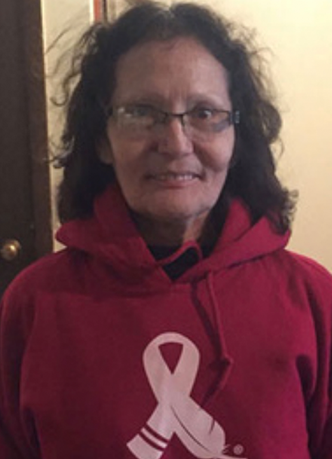
“I was just too scared,” Lugene recalls, “I never thought there was a possibility that I could have cancer. I thought maybe it could have been an STD and I was too embarrassed to find out if that’s why it was abnormal.”
Lugene is sharing her story with the American Indian Cancer Foundation to reach other women out there who have had abnormal Pap results and are afraid. She says that for women who are scared, it’s important to talk about the possibilities with their healthcare provider. Otherwise, circumstances can get worse. She cautions: “Just because you ignore an abnormal test result, it doesn’t mean it’s not there. I ignored it for 11 years and it was still there – getting worse. It’s best to catch it early. The earlier you catch any disease, the better you are to fight it.”
Lugene feels she wouldn’t have been afraid to follow up on her abnormal result if she had had the right education beforehand. She advocates for stronger cervical cancer screening education for women. “It’s important for these young ladies to know how essential Pap tests are. It can save their lives. If they get an abnormal result, they need to have the education in place, in advance.”
For women to be more knowledgeable about their Pap test experience, she advises, “They need to connect with their healthcare provider and ask what’s next, what does that mean, and what is that test? You will find out that the test result is really nothing scary by asking about it. Ask your doctor, ‘How long does it take me to get the results of this test? What does abnormal mean? What are some reasonings that paps come back abnormal?’” Lugene encourages women to be their own advocate if the doctor is not being proactive or supportive enough.
Lugene has seen how the cancer burden has affected American Indians and urges men and women of all ages to prioritize screening. “In our Native communities, cancer runs pretty high. I watched a good friend’s mother die from cancer. I watched her waste away and I don’t want to see people die like that. I hope our people start listening and stop being scared of the unknown. We have to remember that we have to be here for our younger generations.”
Thank you, Lugene Flores for sharing your story.